Pool types
In short: A shipping container pool can stand above ground, partly in the ground or fully in the ground, but its corrugated walls are built and tested to hold cargo in, not soil out. Burying one adds soil pressure on the walls and, when it is empty, groundwater uplift. The National Construction Code requires a pool to withstand loads like these, and it needs approval like any pool.
Key takeaways
- ISO 1496-1 tests a container's side walls with an internal load of 0.6 times its maximum payload, for ship movement, not for soil pressing in.
- An empty pool can move or pop out of the ground from groundwater pressure, so a buried container's design must resist uplift.
- The National Construction Code references no pool shell standard, so applications currently need a performance solution, which may need first-principles engineering design.
- Victoria needs a building permit for pools deeper than 300 mm, including above-ground pools. NSW, Queensland and WA also require approval.
Planning a container pool? Get a quote or call 1300 128 972, and send the pool maker's drawings, a site plan and any soil report you have.
Can a shipping container pool go in the ground?
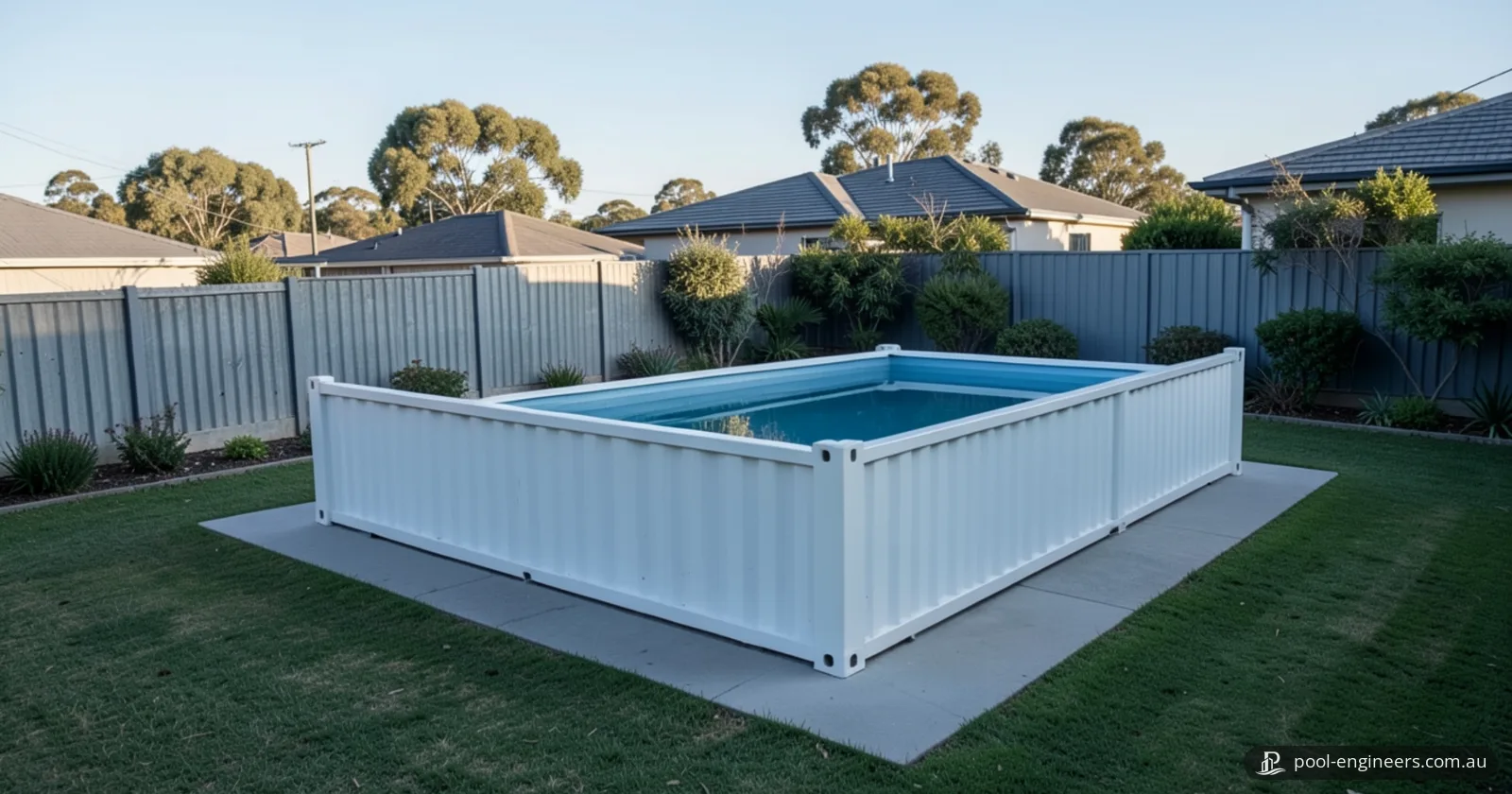
Yes, a container pool can be set partly or fully into the ground, but burying it puts soil and groundwater loads on a steel shell that an above-ground pool never carries. Some are made for above-ground use only: one design entered in Australia's 2021 Good Design Awards is described as "specifically engineered to be above ground", standing on level concrete or on raised steel frames on slopes.
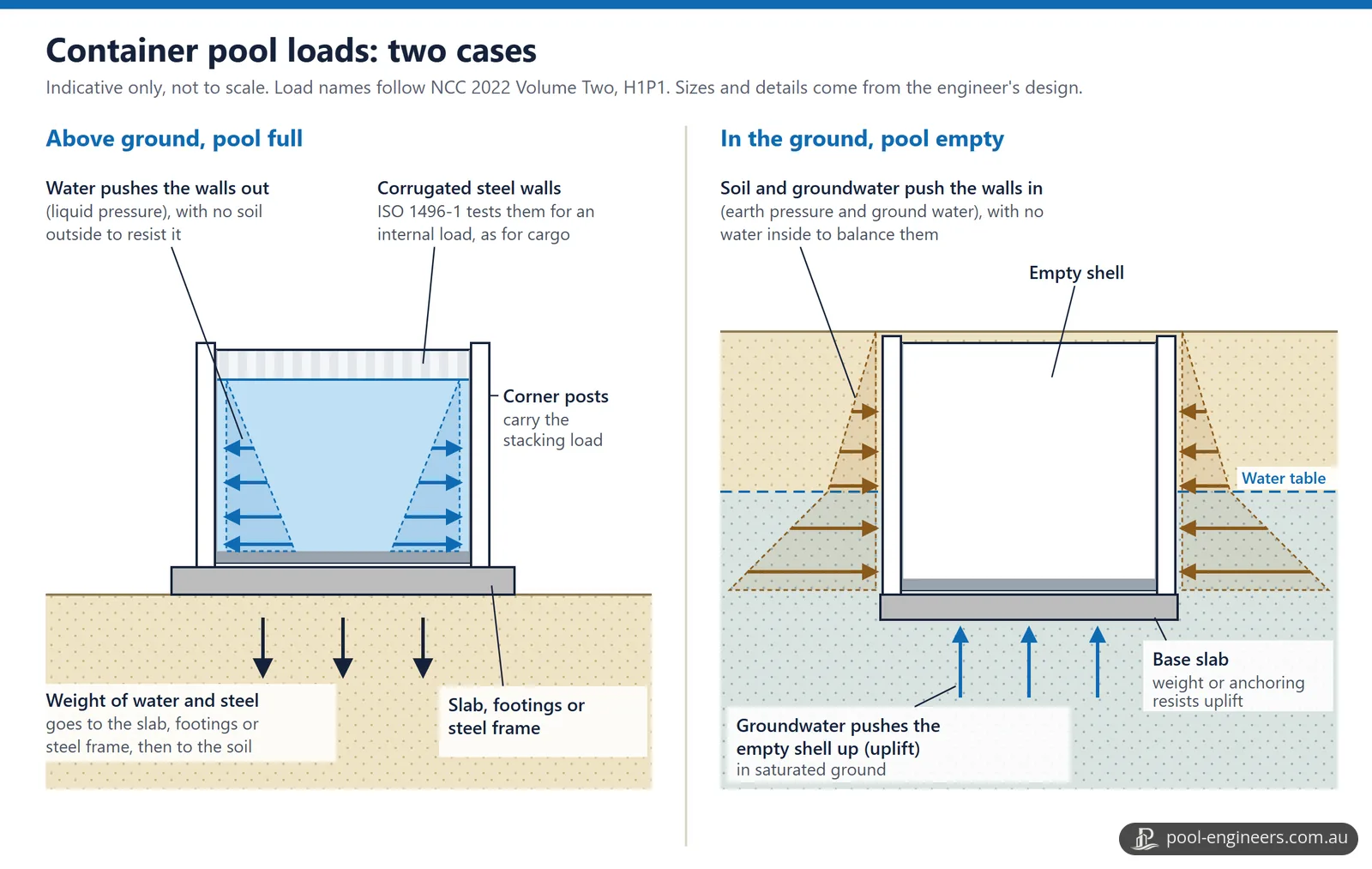
Part H1 of the National Construction Code (NCC) lists the actions a structure must be designed for, including liquid pressure, earth pressure and ground water. The installation decides which apply:
| Installation | Loads on the steel walls | Groundwater uplift when empty | What the engineer designs |
|---|---|---|---|
| Above ground | Water pushing out when full | Not applicable | Slab, footings or steel frame |
| Partly in the ground | Water pushing out; soil and any groundwater pushing in on the buried part | Possible in saturated ground | Base, plus wall checks or retaining for the buried part |
| Fully in the ground | Water pushing out when full; soil and groundwater pushing in, unbalanced when empty | Possible in saturated ground | Wall checks or a soil-retaining structure, base and uplift resistance |
Why is soil pressure a problem for container walls?
Soil pressure is a problem because a shipping container's corrugated walls are designed and tested to hold cargo in, not to hold soil out. ISO 1496-1 (1990 edition), the international standard for general cargo containers, tests each side wall with an evenly spread internal load of 0.6 times the container's maximum payload, to prove it can withstand the forces of ship movement. End walls are tested at 0.4 times the payload. None of the standard's 13 tests is for soil pressing on the outside.
Buried, the walls take soil pressure from outside. While the pool is full, the water inside pushes back. When it is emptied for cleaning or repairs, the soil and any groundwater act on their own. The industry guide by SPASA (the Swimming Pool & Spa Association) gives an engineer's assessment of groundwater, surcharge, reactive clay or partly out-of-ground construction as examples of expert judgement in a pool's approval documents.
So for an in-ground container, the engineer either checks the walls for these loads or designs a structure that carries the soil instead, such as a reinforced concrete surround or a separate pool retaining wall. A partly buried container has both conditions on one wall, as our page on semi-inground pools explains. Surcharge counts too, such as a crane or truck beside the excavation: SPASA lists surcharge, nearby footings and boundary structures among the site conditions to consider.
Can an empty container pool lift out of the ground?
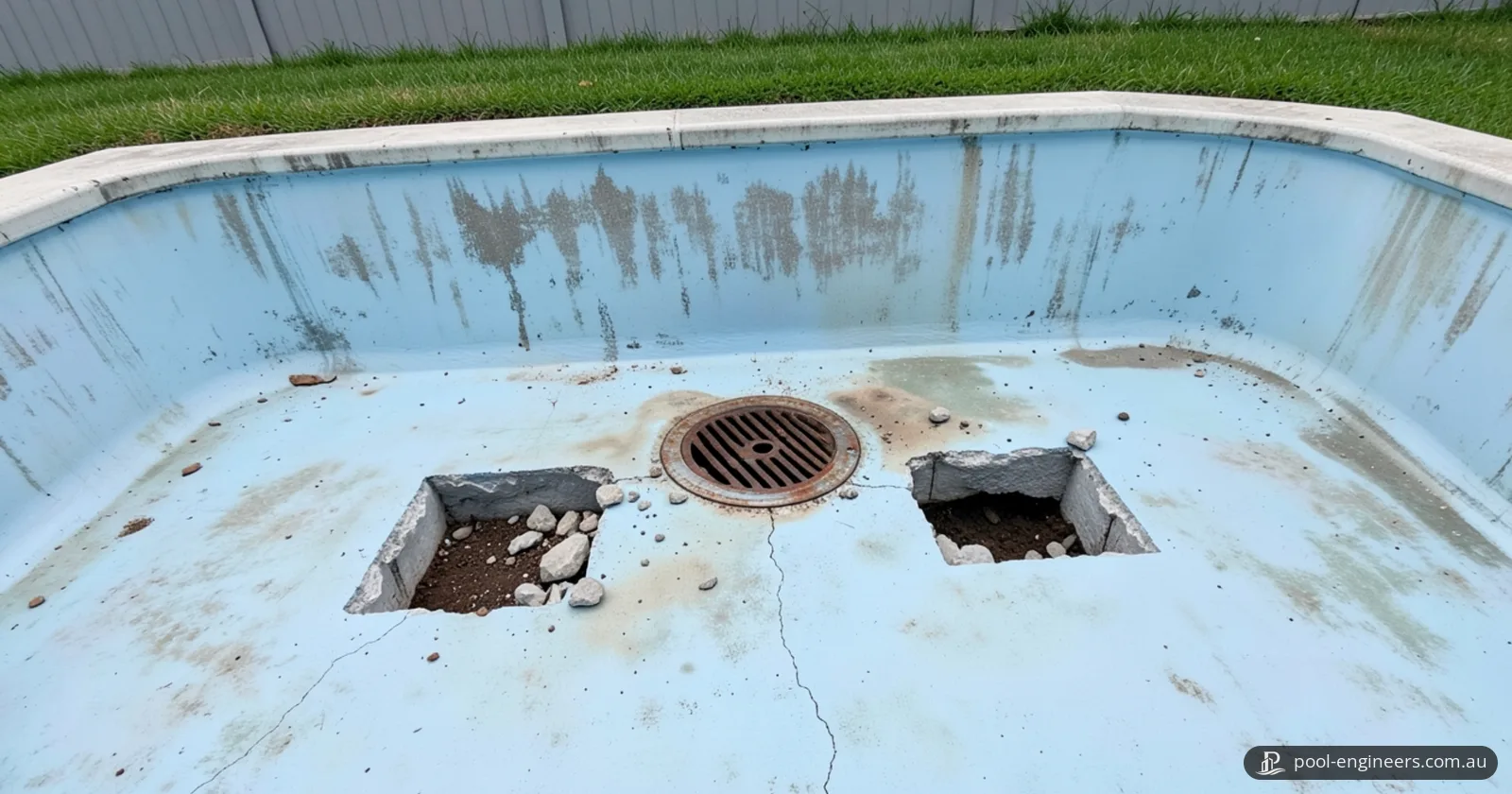
Yes, an empty pool in wet ground can be pushed up by groundwater, and that includes a container pool in the ground. The Queensland Government's waterwise fact sheet says an empty pool "can move or pop out due to ground water pressure". The Northern Territory Government warns that an empty pool, particularly a fibreglass pool, may pop out of the ground in wet conditions. After floods, Queensland Health advises against emptying a pool while the surrounding ground is saturated, as this may result in structural damage.
For a buried container, the engineer checks whether the empty shell, with anything fixed to it such as a concrete base, is heavy enough or anchored firmly enough to stay down. Our guide to hydrostatic pressure and pool uplift explains how added weight, relief valves and anchoring work.
What does a container pool sit on?
A container pool sits on a concrete slab, footings or a steel frame, and that base and the soil below it must carry the full weight of the water and the steel.
In the ISO 1496-1 stacking test (clause 6.2), a container stands on four pads, one under each bottom corner fitting, with its test load spread over the floor. The engineer decides how the container bears on its base, whether a full slab, a footing at each corner or a steel frame on a slope, and sizes it for the soil on the site.
How do cut-outs and joins affect a container pool?
Every cut-out in a container wall, for a window, steps, a skimmer box or a join between two containers, removes steel from the wall, so the engineer checks each one and details the framing or stiffening around it. ISO 1496-1 (clause 5.6) requires that openings in the end or side walls must not impair the walls' ability to pass its wall strength tests. Under clause 5.1, its strength requirements "apply to containers as complete units", and a pool container has its roof cut away. Cuts into the corner posts, which carry the stacking loads between the corner fittings, need particular care.
How does corrosion affect a container pool?
Corrosion matters structurally because the steel walls are the structure, and rust removes steel. A 2013 paper by GHD materials engineers, held in the Australian Steel Institute's library, cites UK bridge guidance that allowance should be made for rust and the resulting loss of structural section.
So the engineer looks at:
- the condition and thickness of the steel, especially in a used container;
- the coating or lining between the pool water and the steel;
- protection for faces buried in soil.
What approvals does a container pool need in NSW, Victoria, Queensland and WA?
A container pool needs the same approvals as any other swimming pool, and its structure has to meet the NCC. The NCC classes a swimming pool as a Class 10b structure. Explanatory information in its Part H7 says a pool must be designed and constructed to withstand any combinations of loads and other actions to which it may reasonably be subjected. This guide cites NCC 2022 because NSW and Queensland adopt NCC 2025 on 1 May 2027; the clauses cited read the same in NCC 2025.
SPASA's guide notes that the NCC does not reference the industry standards for pool shells (AS 2783 for concrete, AS 1838 and AS 1839 for fibreglass), so a building application currently needs a performance solution, which may require engineering designs using first-principles calculations. None of those standards is written for a steel container.
| State | What the official source says |
|---|---|
| NSW | Development consent through a complying development certificate (CDC) or a development application (DA) (City of Newcastle). A CDC pool must be behind the building line, with its waterline at least 1 m from side and rear boundaries (NSW Planning). |
| Victoria | A building permit for a pool or spa deeper than 300 mm, including above-ground pools (Consumer Affairs Victoria), from a registered building surveyor, with drawings showing NCC compliance (Building and Plumbing Commission). |
| Queensland | Building approval from your council or a private certifier before building, with architectural plans and engineering specifications (Queensland Building and Construction Commission, QBCC). |
| Western Australia | Building approval for all swimming pools and spas (Building and Energy). |
A compliant safety barrier is required as well, under NCC Volume Two Part H7 in NSW, Victoria and WA, and under the Building Act 1975 in Queensland (NCC 2022 Volume Two, Part H7). Our guide to pool building permits walks through each state's approval pathway.
When to call a structural engineer
Call a structural engineer before you order the pool if any of these apply:
- the container will be partly or fully in the ground;
- the site slopes, has been filled, or has a high water table;
- a house footing, boundary wall or retaining wall is close to the pool;
- you plan windows, steps, a skimmer or a join between containers;
- the pool will stand on an existing slab, deck or balcony.
Our pool structural engineering service covers the shell, any retaining and the site around it, and the pool engineering plans page lists the drawings, calculations and report you receive.
Example from our projects
Neither is a container pool, but each shows a point above in practice:
- Above-ground pool deck and slab, Gladstone Region QLD: a 100 mm reinforced slab with thickened edges carries a 7.5 m above-ground pool and its deck, on natural clay of at least 180 kPa allowable bearing pressure or on bedrock.
- Partly above-ground concrete pool, Middle Park VIC: on a Class P site, the shell stands on eight screw piers down to stable hard strata, with extra reinforcement around the skimmer box.
Frequently asked questions
Is a container pool exempt from approval as a portable pool?
Unlikely, going by the official thresholds. In NSW, the City of Newcastle says exempt development covers portable pools under 2,000 L, and pools that can hold 2,000 L or more need development consent. In Victoria, the exemption from a building permit covers temporary inflatable pools and portable spas, according to Consumer Affairs Victoria.
Can a container pool sit on a deck or balcony?
Not without an engineer checking the deck first. The NCC 2022 explanatory note on attaching framed decks and balconies to a house says a 2 kPa imposed load suits domestic activities but is not appropriate where a deck or balcony supports spa or bathing pools. Above 2 kPa, the framing must be designed by a professional engineer or other appropriately qualified person.
Can I use the pool maker's engineering for my approval?
Possibly, if it covers your site. The Building and Plumbing Commission says a Victorian permit application must include detailed drawings and specifications, and list the building practitioners who prepared them. SPASA's guide stresses that a performance solution needs project-specific evidence, so a standard design may need extra engineering for your soil, slope and groundwater.
Will I need a soil report for a container pool?
Possibly. SPASA's guide lists a soil report, site plan and engineer advice as the evidence for site conditions such as fill, retaining walls and nearby footings. A structural report is a separate question: in Queensland, the Queensland Building and Construction Commission (QBCC) says your certifier will let you know if you need to engage an engineer to do a structural report, if you are building on a difficult site.
Sources
- ISO 1496-1:1990, Series 1 freight containers, Part 1: General cargo containers for general purposes (international standard; copy published by Public.Resource.Org)
- Australian Building Codes Board: NCC 2022 Volume Two, Part H1 Structure
- Australian Building Codes Board: NCC 2022 Volume Two, Part H7 Ancillary provisions and additional construction requirements
- Australian Building Codes Board: NCC 2022 Volume Two, Part A6 Building classification
- Australian Building Codes Board: NCC 2025 state and territory adoption information
- Australian Building Codes Board: NCC 2025 Volume Two, Part H1 Structure
- Australian Building Codes Board: NCC 2025 Volume Two, Part H7 Ancillary provisions and additional construction requirements
- Australian Building Codes Board: NCC 2025 Volume Two, Part A6 Building classification
- SPASA (Swimming Pool & Spa Association): Applying the NCC to swimming pool and spa projects, an industry guide
- Good Design Australia: Good Design Awards 2021, above-ground shipping container pool entry
- Queensland Government: How to be waterwise, pools and spas (fact sheet)
- Northern Territory Government, SecureNT: Swimming pools
- Queensland Health: Swimming pool safety after a disaster
- R. Low and P. Sandeford (GHD): A review of environmental factors determining the use of weathering steel in structural applications, Corrosion & Prevention 2013 (Australian Steel Institute library)
- City of Newcastle: Swimming Pool/Spa
- NSW Department of Planning, Housing and Infrastructure: Swimming pools (complying development)
- Building and Plumbing Commission (Victoria): Installing a new pool or spa
- Consumer Affairs Victoria: Outdoor home building projects checklist
- Queensland Building and Construction Commission: Build a pool
- Government of Western Australia, Building and Energy: Swimming pool and spa safety barrier requirements