Existing pools
In short: Pool removal either takes the whole shell, coping and pipework out and refills the hole, or leaves the shell in place with holes cut through its floor and fills it. Several NSW councils expect full removal, while some Victorian and Queensland councils accept a holed and filled shell. Either way the fill should be clean and compacted, and footings over it later depend on its AS 2870 site classification.
Key takeaways
- Fairfield, Kiama and Bayside councils (NSW) generally expect the whole pool shell, plumbing and coping removed, not buried.
- The Queensland Building and Construction Commission says a decommissioned pool must not be able to hold more than 300 mm of water.
- Maroondah (VIC) says to cut at least two 50 cm by 50 cm squares in the base of a buried pool, at the deep end.
- Belmont and Cottesloe (WA) ask for the excavation to be backfilled in layers with clean sand, compacted in accordance with AS 3798-2007.
- The National Construction Code's Housing Provisions refer filled sites to AS 2870 for site classification, and Class P sites to it for design.
Removing or filling in a pool before you build over the spot? Send us photos and your plans for a quote, or call 1300 128 972.
What is the difference between full pool removal and filling in a pool?
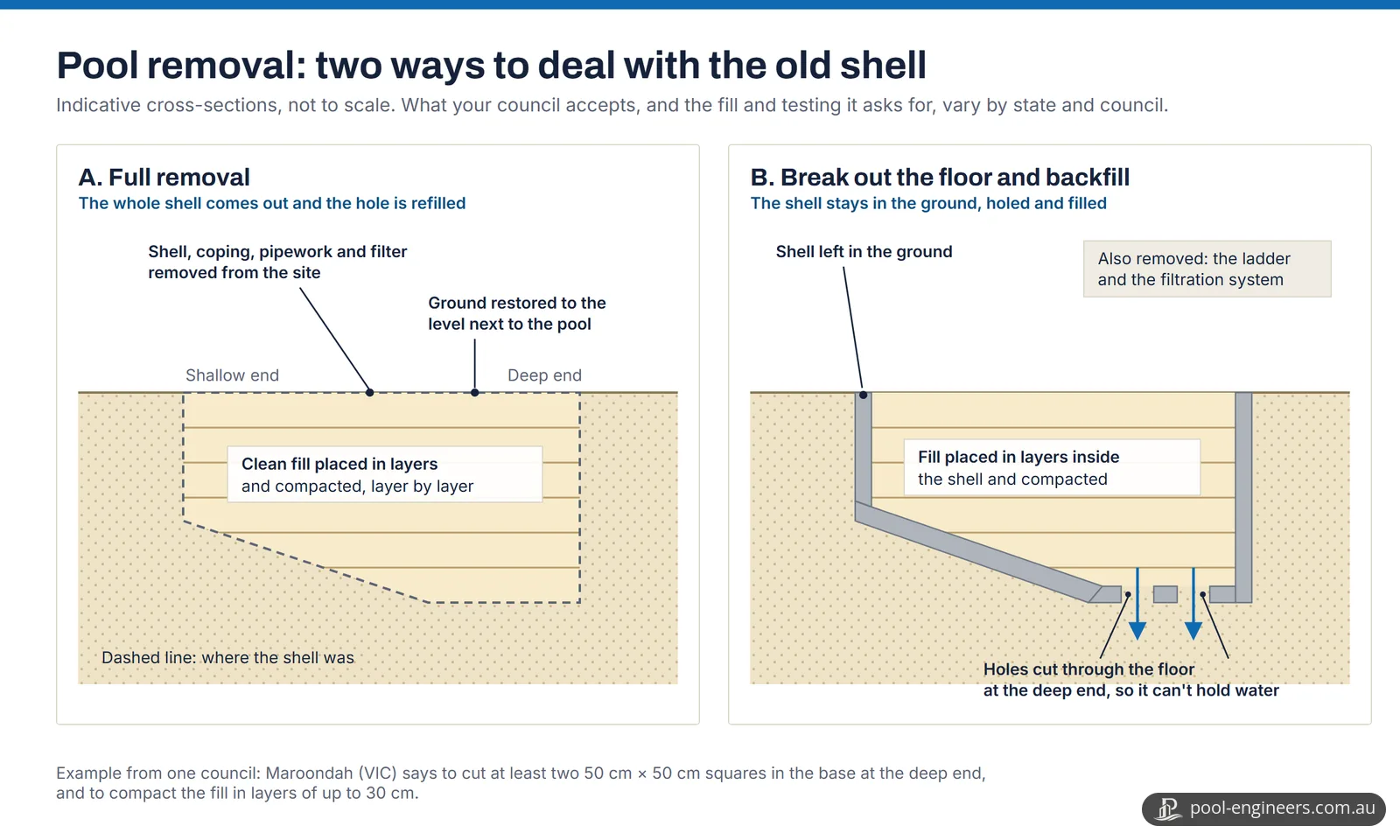
Full pool removal takes the whole shell out of the ground and refills the hole, while filling in a pool leaves the shell where it is, breaks holes or sections out of it and backfills it. NSW Planning's guide to demolition of buildings says that where demolition involves removing a swimming pool, any piping must be removed and the site restored to the ground level next to the pool with compacted fill. For the in-place method, Fraser Coast Regional Council (QLD) lists demolishing part of the pool wall or floor, punching drainage holes through the base, and removing sections of the structure and the filtration system.
Council guidance shows how the two methods differ:
| Full removal | Break out the floor and backfill | |
|---|---|---|
| The shell | Removed with the coping, plumbing, pipework, cabling and filters (Fairfield, NSW) | Left in the ground and holed so it can no longer hold water (Maroondah, VIC) |
| The fill | Clean fill or excavated natural material (ENM), well compacted, with no demolition waste (Fairfield, NSW) | Soil endemic to the site, compacted in layers of up to 30 cm (Maroondah, VIC) |
| Inspection | An officer inspects the site to confirm the pool has been removed (Belmont, WA) | A council inspection before filling, with photos of the excavation showing the cut-out holes (Stonnington, VIC) |
| Building on it later | Belmont (WA) says consideration needs to be given to removing the entire shell so it doesn't affect future development | Maroondah (VIC) says burying a below-ground pool may cause potential issues for future development |
Why does a filled-in pool need holes in its floor?
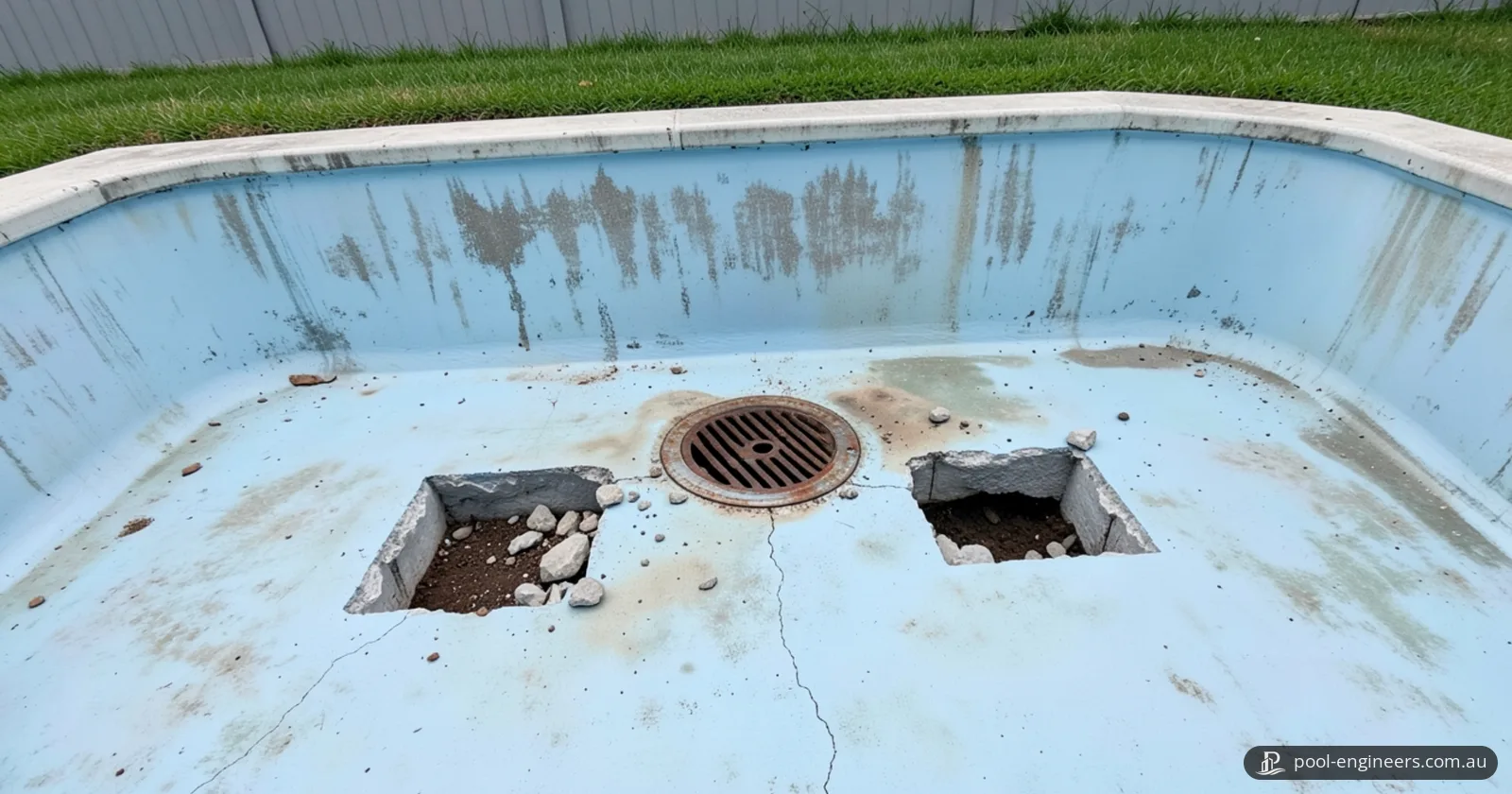
A pool shell left in the ground needs holes through its floor so it can no longer hold water, which is how Queensland's building regulator and councils such as Maroondah (VIC) judge a decommissioned pool. The Queensland Building and Construction Commission (QBCC) says a decommissioned pool must not be able to hold more than 300 millimetres of water, and Maroondah says the main consideration is ensuring it is unable to hold water.
Council instructions for the holes differ:
- Maroondah (VIC): for a buried concrete or fibreglass pool, cut at least two 50 cm × 50 cm squares in the base at the deep end.
- Stonnington (VIC): cut two holes of at least 500 mm × 500 mm in the deep end, and remove the ladder and filtration system.
Maroondah warns that in some areas, impervious soil types or high ground and perched water tables may make holing pools problematic, and that advice from a suitably qualified structural or hydraulic engineer may be needed. Our guide to hydrostatic pressure and pool uplift explains why an emptied pool can lift on a site with a high water table.
How should the fill in an old pool be compacted?
The fill in an old pool should be clean and compacted, and Belmont and Cottesloe (WA) and Maroondah (VIC) say to place it in layers. The City of Belmont and the Town of Cottesloe (WA) both say the remaining excavation should be backfilled in layers with clean sand and compacted in accordance with AS 3798-2007, Guidelines on earthworks for commercial and residential developments.
Other councils set out the material and the proof:
- Material: Kiama Council (NSW) accepts only certified clean fill or certified excavated natural material. Fraser Coast (QLD) asks for clean, non-toxic fill such as sand or gravel.
- Compaction: Fraser Coast says the fill must be properly compacted to prevent future ground movement.
- A compaction certificate: Fraser Coast says a registered engineer may be required to inspect the works, which may include a compaction certificate confirming the filled area is structurally suitable.
- Drainage after full removal: on Logan City Council's (QLD) notification form, owners who have completely removed a pool declare that compacted clean non-toxic sand, dirt or gravel was used to backfill it and that permanent drainage has been provided to the base of the excavation.
Can you build over a filled-in pool?
Building over a filled-in pool is possible, but the footings depend on the site's classification under AS 2870, Residential slabs and footings. The National Construction Code (NCC) Housing Provisions require foundations to be classified in accordance with AS 2870, list filled sites against it, and refer Class H, E and P sites to it for design and construction information. The wording is the same in NCC 2022 and NCC 2025.
Penrith City Council (NSW) set out the difference between controlled fill and other fill in March 2021, when it amended the notations for lots on fill deeper than 400 mm in its Jordan Springs East precinct:
| Controlled fill | Fill without that evidence | |
|---|---|---|
| What it means | Fill shown to comply with the technical and control requirements for the earthworks at the time it was placed | Fill that can't be shown to meet those requirements |
| Site class under AS 2870 | A Class P site can be reclassified using engineering principles | In Jordan Springs East, lots on fill deeper than 400 mm keep the default classification, Class P |
| What it allows | Standard deemed-to-comply slab and footing designs | Footing systems designed to the engineering principles AS 2870 specifies for Class P sites |
Penrith also said cone penetration testing done after the earthworks were finished was not a permissible basis for reclassifying those lots. For a filled pool, Fairfield, Kiama and Bayside (NSW) ask owners to keep receipts for all fill delivered, and Fraser Coast (QLD) says a compaction certificate may be required.
The Housing Provisions' own fill details under a slab are shallow. Under clause 4.2.4, controlled sand fill goes up to 800 mm deep in layers of no more than 300 mm, and controlled clay fill up to 400 mm in layers of no more than 150 mm. An explanatory note to clause 4.2.5 says fill beyond these depths will need to be installed in accordance with clause H1D4(1) of NCC Volume Two, the clause that accepts footings and slabs designed to AS 2870 or AS 3600. A pool hole can be much deeper: the in-ground concrete pool we designed in Tallai on the Gold Coast is 1000 mm deep at the shallow end and up to 1800 mm at the deep end.
What approvals does pool removal need in NSW, Queensland and Victoria?
Pool removal approvals depend on the state and often the council: in NSW the work may be exempt development or need a complying development certificate (CDC) or development application (DA), in Queensland decommissioning may need building approval, and Stonnington and Maroondah councils (VIC) say removal may need a building permit.
| State | What official sources say |
|---|---|
| NSW | Only pools that could be built as exempt development under State Environmental Planning Policy (Exempt and Complying Development Codes) 2008 may be removed without approval; otherwise a CDC or DA must be approved first (Kiama). NSW Planning lists swimming pools among structures that can usually be demolished under a CDC. The City of Parramatta says pool removal will also require a DA. |
| Queensland | The QBCC says a pool must lawfully be decommissioned, which may require building approval, so check with the local council before starting. The City of Moreton Bay says you must get building approval before decommissioning a pool or spa, and Fraser Coast says demolition, removal or conversion of a regulated pool requires approval from a private building certifier. |
| Victoria | Stonnington says complete demolition and removal of an in-ground pool may require a building permit. Maroondah says pools located less than their depth away from any building or boundary fence may require a building permit before removal. |
In NSW, Bayside and Kiama councils consider keeping all or part of a pool shell only in specific circumstances where full removal may be impractical or unsafe, and only through a DA, not as complying development. Kiama says this will likely put a notation on the property title identifying buried waste, and Bayside says an approval may require the coping to be left exposed so later owners know a disused pool shell is there.
When to call a structural engineer
Call a structural engineer before the pool comes out if it sits close to a house or boundary, or if anything will be built over the filled area:
- The pool is close to a building or boundary. Maroondah says consideration should be given to protecting the adjoining property owner before a below-ground pool is removed.
- You're choosing the method and the fill. Stonnington strongly recommends written advice from an engineer on how to remove the pool or spa and which filling material to use.
- A slab, extension or granny flat will go over the spot. The footing design then depends on a site classification under AS 2870 that accounts for the fill.
Our pool inspections and assessments cover an existing pool's structure, any retaining structures associated with it and site drainage, and end in a written engineering report. We work across Australia; the service areas page lists the cities we cover.
Frequently asked questions
Do I need to take a removed pool off the pool register?
Yes, in NSW, Queensland and Victoria. Fairfield, Kiama and Bayside councils (NSW) say to make sure the pool is taken off the government swimming pool register once removal is complete, and the QBCC needs a written request to take a regulated pool off its register. Maroondah (VIC) removes a pool from its Swimming Pool and Spa Register once it has inspected the area and is satisfied with the works.
Can broken concrete from the pool shell go back into the hole?
Not in the NSW councils checked. Fairfield, Kiama and Bayside say pieces of the pool shell or coping can't be used as fill, and Fairfield and Bayside class them as demolition waste that must be removed from the site and taken to a licensed disposal facility.
Where can the pool water go before demolition?
That depends on your water authority and council. In Queensland, the City of Moreton Bay says to contact Unitywater before emptying pool water into the sewer, allows stormwater only if the water has no chemicals and a pH of 6.5 to 8.5, and otherwise points to a licensed liquid waste contractor.
Can an old pool be turned into a fishpond instead?
Not without approval in Queensland's Fraser Coast region. Fraser Coast Regional Council treats converting a pool to a fishpond or ornamental water feature like demolition or removal: it needs approval from a private building certifier, and a notification to council once the work is done.
Does an above-ground pool need the same process?
An above-ground pool can usually be dismantled rather than demolished. Fairfield (NSW) notes these pools are often bought in kit form and can usually be taken apart with hand tools, and Kiama (NSW) says a portable pool or spa that meets all the exempt criteria can be removed without a CDC or DA.
Sources
- NSW Planning: Demolition of buildings
- Fairfield City Council (NSW): Fact sheet, removal of a swimming pool
- Kiama Municipal Council (NSW): Removal of a swimming pool fact sheet
- Bayside Council (NSW): Removal of a swimming pool infosheet
- City of Parramatta (NSW): Swimming pool requirements
- Queensland Building and Construction Commission: Register a pool
- Fraser Coast Regional Council (QLD): Swimming pools or spas
- City of Moreton Bay (QLD): Swimming pools, spas and portable wading pools
- Logan City Council (QLD): Notification of swimming pool or spa removal
- Maroondah City Council (VIC): Decommissioning or removal of swimming pools and spas
- City of Stonnington (VIC): Decommission a swimming pool or spa
- City of Belmont (WA): Notification of removed swimming pool/spa
- Town of Cottesloe (WA): Notification of removed swimming pool/spa
- ABCB: NCC 2022 Housing Provisions, Part 4.2 Footings, slabs and associated elements
- ABCB: NCC 2025 Housing Provisions, Part 4.2 Footings, slabs and associated elements
- ABCB: NCC 2022 Volume Two, Part H1 Structure (clause H1D4)
- Penrith City Council (NSW): Jordan Springs East amended notations, supplementary information (March 2021)